Face Shape Detector Free vs Manual Measurement: Which Should You Use?
Compare a free photo-based detector with the classic four-measurement method, then use the option that fits your time, privacy preferences, and need for a second opinion.
The short answer: combine speed with a reality check
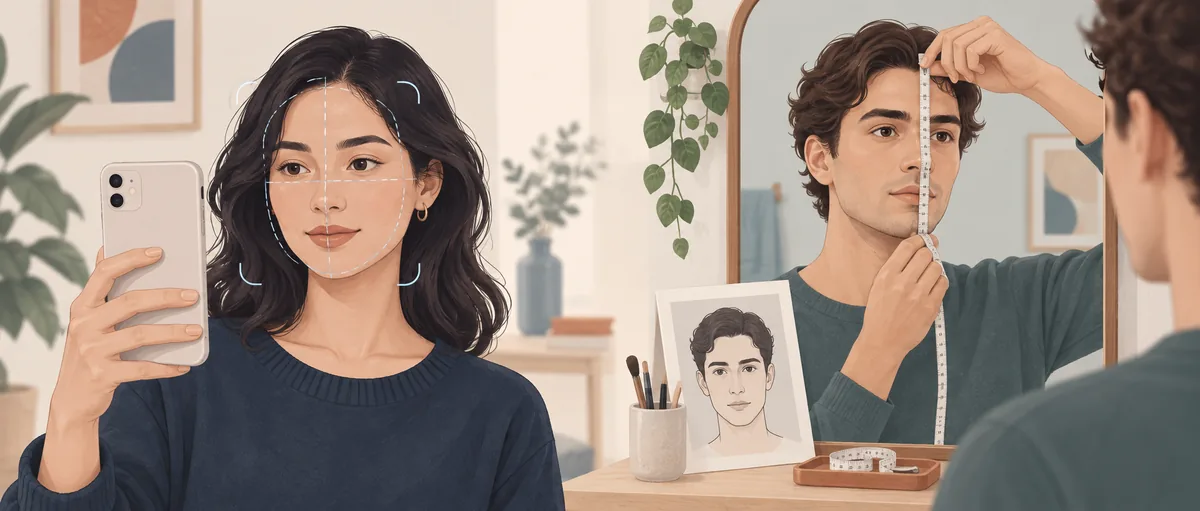
A face shape detector free tool is the quickest way to get a first result from a clear front-facing photo. It can estimate the visible outline, compare proportions, and suggest a closest category without asking you to place a tape measure on your face. Choose it when you want a fast starting point, a second opinion, or an answer before trying glasses, hair, or makeup ideas.
Manual face shape measurement is better when you want to understand why the answer fits. Measuring face length, forehead width, cheekbone width, and jawline width gives you concrete reference points. It also works without uploading a photo, which makes it the better choice for readers who prefer an offline or privacy-first check.
For most people, the strongest method is hybrid: use a free face shape detector online for a quick suggestion, then confirm the result with the four measurements and a shape chart. If both methods point in the same direction, confidence improves. If they disagree, inspect the photo angle, hair, lighting, and the two closest shape descriptions instead of forcing a perfect label.
What manual face shape measurement involves
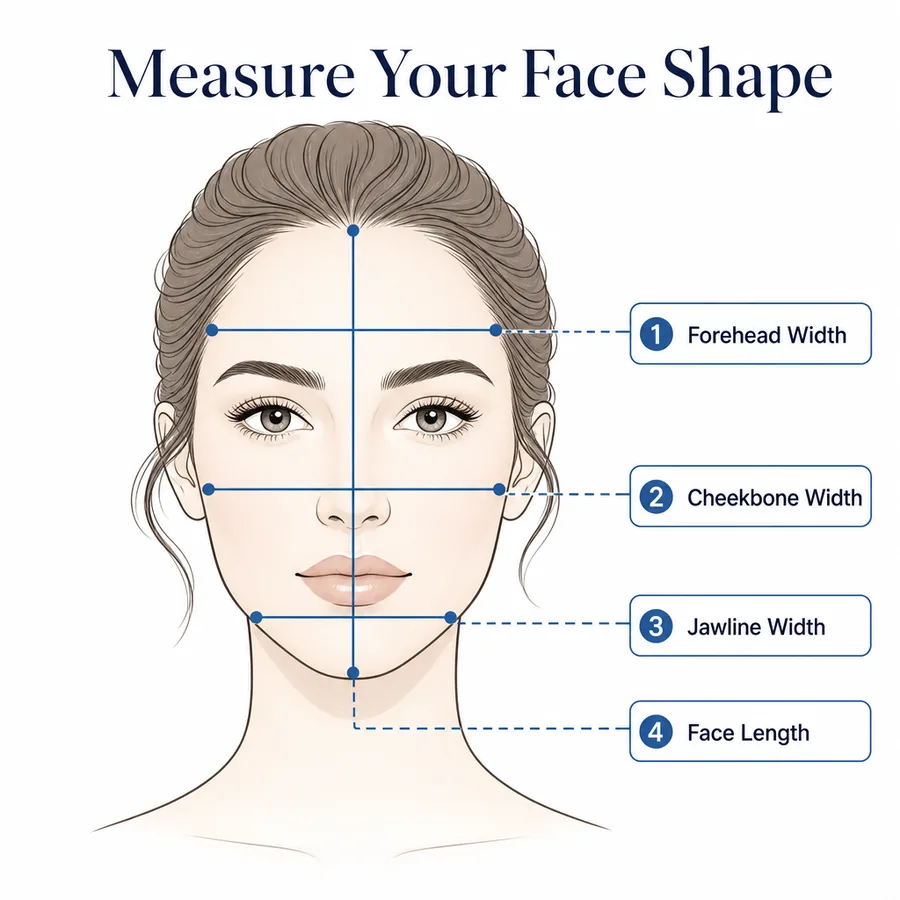
Manual measurement does not need laboratory precision. It needs consistent points and a front-facing view. Use a soft measuring tape if possible, keep your head level, pull hair away from your forehead and jaw, and write down the numbers in either inches or centimeters. If you are measuring from a photo, avoid a close wide-angle selfie because it can enlarge the center of the face.
The goal is to compare the pattern, not to win a contest over a single millimeter. A face that is clearly longer than wide reads differently from one with similar length and width. The widest area and the character of the jawline usually settle the close calls.
Set up a neutral reference
Stand in even light or choose a straight-on photo taken at eye level. Relax your expression and move hair away from the face so temporary styling does not become part of the measurement.
- Keep the camera far enough away to avoid wide-angle distortion.
- Do not tilt your head or measure from a three-quarter angle.
- Use the same photo if you repeat the check later.
Measure face length
Measure from the natural hairline down to the bottom of the chin. If the hairline is difficult to see, estimate the natural start of the forehead and keep the tape centered.
- Length is the strongest clue for oblong and oval faces.
- Do not follow the curve of the nose with the tape.
- A clearly long face is rarely a classic round shape.
Measure the three widths
Record the widest forehead span, cheekbone span, and jawline span. For the jaw, measure across the broadest visible points or measure from the chin to one jaw angle and double it.
- Cheekbone width helps separate diamond from heart.
- A broad angular jaw supports square or rectangular patterns.
- A lower face wider than the forehead can point toward triangle or pear.
Compare the pattern
Look at which area is widest, whether length dominates width, and whether the jaw is soft, angular, broad, or tapered. Then compare the pattern with the chart rather than relying on one number.
- Similar length and width plus a soft jaw often suggests round.
- Balanced widths plus a strong jaw often suggests square.
- A longer face with balanced widths often suggests oval or oblong.
Face shape comparison chart
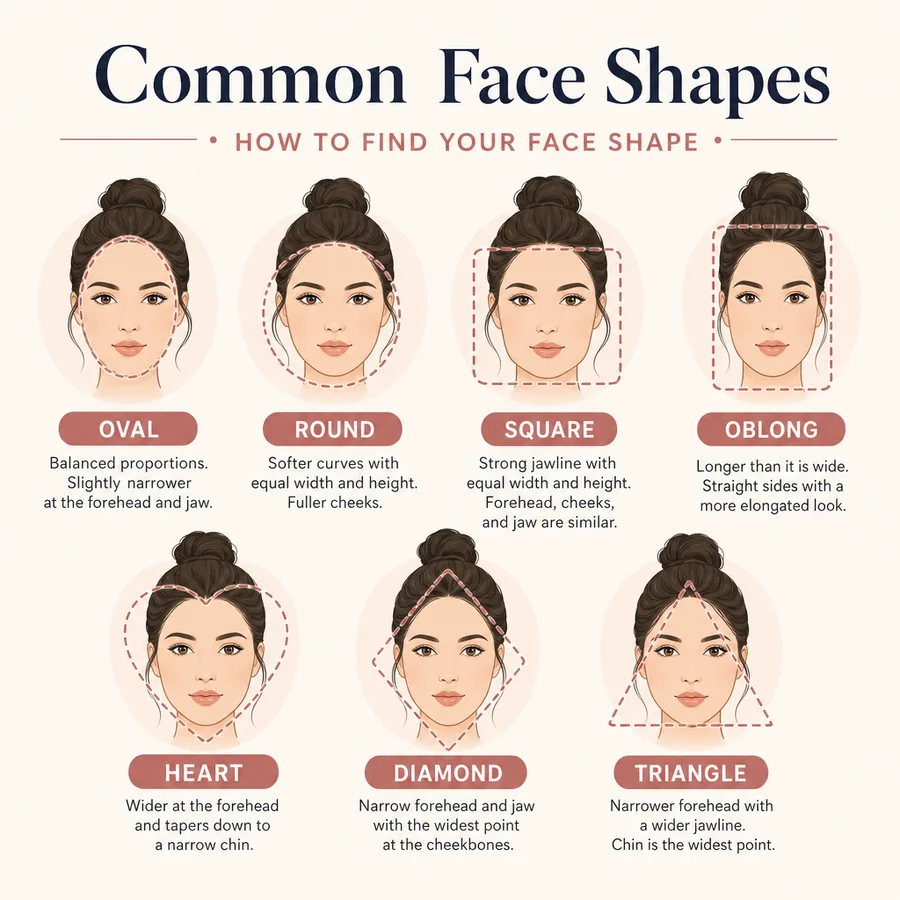
Use this chart to check both a free detector result and a manual estimate. The categories are practical descriptions, not strict biological boundaries. If two rows fit, read the tie-breakers below.
| Face shape | Widest point | Length vs width | Jawline | Best clue |
|---|---|---|---|---|
| Oval | Cheekbones or forehead | Longer than wide, but not extremely long | Soft and gently rounded | Balanced proportions without one dramatic edge |
| Round | Cheeks | Length and width are close | Soft and curved | Fuller cheeks and little visible angularity |
| Square | Forehead, cheekbones, and jaw are similar | Length and width are close or balanced | Broad, strong, and angular | The lower face has a clear squared edge |
| Oblong | Widths are often similar | Length is clearly greater than width | Square or softly defined | The face reads long before it reads wide |
| Heart | Forehead | Short, balanced, or slightly long | Narrows toward the chin | A wider upper face with a smaller chin |
| Diamond | Cheekbones | Often a little longer than wide | Narrower jaw and chin | Cheekbones stand out while both ends are narrower |
| Triangle | Jawline | Varies | Broadest part of the face | The lower face is wider than the forehead |
When two face shapes look close
Mixed results are normal. A photo detector may see an oval outline while your measurements suggest oblong because a slight camera angle increases the apparent length. A manual check may suggest heart while the detector says diamond because the forehead and cheekbones are close in width. These are not necessarily errors; they are reminders that face-shape categories overlap.
Use the feature that changes your real styling decision most. If you are choosing glasses, jaw width and overall length may matter more than a small difference in forehead width. If you are choosing a haircut, the amount of vertical length and where volume sits may matter more than the label itself. Record a dominant shape plus a secondary influence when that is more honest.
| Close call | Check first | Practical decision |
|---|---|---|
| Oval vs oblong | Does length clearly dominate? | Choose oblong when the face reads distinctly long; choose oval when proportions feel balanced. |
| Round vs square | Is the jaw soft or angular? | Choose round for a curved lower face; choose square for a broad defined jaw. |
| Heart vs diamond | Is the forehead or cheekbone area widest? | Choose heart when the upper face dominates; diamond when the cheekbones do. |
| Triangle vs square | Is the jaw wider than the forehead? | Choose triangle when the lower face is widest; square when widths are similar. |
Face shape detector free vs manual measurement
A free AI face shape detector is convenient because it turns a clear photo into a quick suggestion. It can be useful when you are curious, when you want to compare a result with a friend, or when you find it difficult to place measurement points on your own face. The best tools explain the result in terms of visible proportions rather than presenting a mysterious score.
Manual measurement is slower but more transparent. You can see which width is largest, repeat the numbers, and avoid uploading a face photo. It is especially helpful when a tool result changes between photos or when you want to understand the difference between two nearby categories. Neither method deserves blind trust: photo quality, pose, hair, lighting, and landmark placement can all change the result.
| Method | Best for | Advantages | Limits |
|---|---|---|---|
| Free face shape detector | A fast first opinion from a clear photo | Quick, visual, and easy to repeat | Sensitive to angle, lighting, hair, and tool quality |
| Manual four-point method | Understanding proportions and privacy | Transparent, offline-friendly, and repeatable | Slower and dependent on consistent landmark placement |
| Hybrid check | Close calls or important styling choices | Combines speed with a visible reality check | Requires a second step when the two answers disagree |
Want a fast second opinion?
Try the face shape detector with a clear front-facing photo, then compare its suggestion with the measurements and chart in this guide.
Try the Face Shape DetectorThe best next step after this comparison
If you need an answer now, start with one clear front-facing photo in neutral light and use the free detector as a first pass. Save the result only as a hypothesis. Then compare the widest point, length-to-width impression, and jawline with the chart. This takes less time than repeating a tool with five different selfies and trusting whichever label sounds best.
If you are making a styling decision, apply the result to one choice at a time. Frame width and shape matter for glasses; volume placement matters for hair; contour and blush placement matter for makeup. Face shape is a practical organizing idea, not a rule about attractiveness or what you are allowed to wear.
Frequently asked questions
It can be useful as a quick second opinion, but accuracy depends on the photo, camera angle, lighting, hair, expression, and the tool's method. Confirm a close result with the four manual measurements.
Manual measurement is more transparent and can be done without uploading a photo. AI is faster and easier for a first pass. For close categories, using both is usually more useful than choosing one as universally better.
Use a sharp, front-facing photo at eye level with even light, a neutral expression, and hair pulled away from the forehead and jaw. Avoid close wide-angle selfies, heavy filters, and strong side angles.
Tools may use different landmark definitions, thresholds, and shape categories. The input photo can also change the visible outline. Compare the two closest descriptions and check the measurements instead of treating one label as absolute.
Only if you are comfortable with the tool's stated processing and storage practices. If you prefer not to upload, use a mirror, measuring tape, and the manual comparison chart instead.