How to Find Your Face Shape in 5 Steps: Measure, Compare, and Confirm
A practical guide to finding your face shape with a quick visual check, four simple measurements, a comparison chart, and an optional AI face shape detector when your features sit between two categories.
The quick answer: how to find your face shape
The most reliable way to find your face shape is to compare four measurements: face length, forehead width, cheekbone width, and jawline width. Then confirm the result by looking at the jaw angle and chin shape. This gives you more useful information than staring at one selfie and guessing whether your face is oval, round, square, heart, diamond, oblong, or triangle.
If you want a fast answer, start with three visual clues. First, identify the widest part of your face: forehead, cheekbones, or jawline. Second, compare face length with face width: is your face close to equal in both directions, or clearly longer than it is wide? Third, look at the jaw and chin: are they soft and rounded, square and angular, narrow and pointed, or broad and strong?
Many people do not fit one category perfectly. Your best answer may be a dominant face shape with a secondary influence, such as oval with a slightly heart-shaped forehead, round with a stronger jaw, or oblong with diamond-like cheekbones. That is normal. The goal is not to force your face into a box; the goal is to find the closest practical label so hair, glasses, makeup, and beard advice becomes easier to use.
The 60-second face shape check
Before measuring, do a quick mirror check. Stand in natural light, pull your hair away from your face, relax your expression, and look straight ahead. This quick pass will not be as precise as measurements, but it helps you notice the signals that matter most.
Find the widest point
If your cheekbones are widest, diamond or oval may be likely. If your forehead is widest and the chin narrows, heart may be likely. If the jaw is widest, triangle or square may be closer.
Compare length and width
A face that is much longer than it is wide often points toward oval or oblong. A face with similar length and width may point toward round or square, depending on the jawline.
Read the jaw and chin
A soft jaw suggests oval or round. A strong horizontal jaw suggests square or rectangle. A narrow or pointed chin often appears in heart or diamond face shapes.
How to measure your face shape in 5 steps
For a more dependable answer, use a soft measuring tape, a mirror, and a front-facing photo. Keep your head level, pull hair away from the hairline and jaw, and avoid smiling or raising your brows. If you only have a photo, choose one taken from eye level rather than a close wide-angle selfie.
You do not need perfect medical precision. You need consistent comparison points. Record each number in inches or centimeters, then compare which areas are widest and whether your face length is close to or clearly longer than your width.
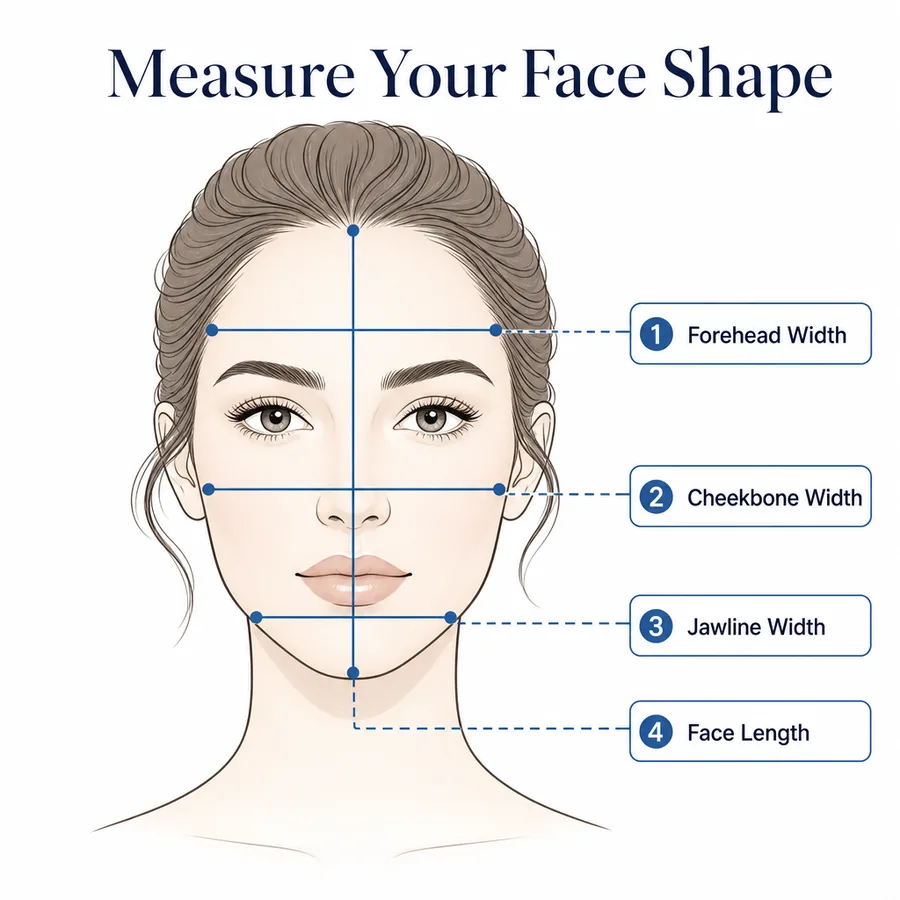
Measure your face length
Measure from the center of your hairline down to the bottom of your chin. If your hairline is not easy to see, estimate the natural start of the forehead rather than measuring from the top of your hair.
- Face length is the strongest clue for oblong and oval shapes.
- Keep the tape centered instead of following the curve of the nose.
- A clearly long face is usually not round, even if the cheeks are full.
Measure your forehead width
Measure across the forehead at one of its wider points, often around the midpoint between the hairline and brows. Keep the tape straight across rather than angled.
- A forehead wider than the jaw can point toward heart or oval.
- A narrow forehead with a wider jaw can point toward triangle or pear.
- Hair volume can make the forehead look wider than it really is.
Measure your cheekbone width
Find the most prominent point of each cheekbone and measure straight across. This is often the widest part of diamond faces and many oval faces.
- Cheekbone width is a useful tie-breaker for diamond vs heart.
- Strong cheekbones do not automatically mean diamond if the forehead is also wide.
- Use the bone structure, not blush placement or contour, as your guide.
Measure your jawline width
Measure across the jaw around the broadest visible points, or measure from the chin to one jaw angle and double it. The important question is whether the lower face is narrow, balanced, or broad.
- A broad, angular jaw supports square or rectangle.
- A jaw wider than the forehead supports triangle or pear.
- A tapered jaw with a narrow chin supports heart or diamond.
Compare the numbers with your jaw angle
Now look at the pattern. The largest number tells you the dominant width, face length tells you whether the face is elongated, and jaw angle tells you whether the shape reads soft, square, tapered, or pointed.
- Similar length and width plus a soft jaw suggests round.
- Similar widths across forehead, cheekbones, and jaw plus an angular jaw suggests square or rectangle.
- Longer face length with balanced widths suggests oval or oblong.
Face shape comparison chart
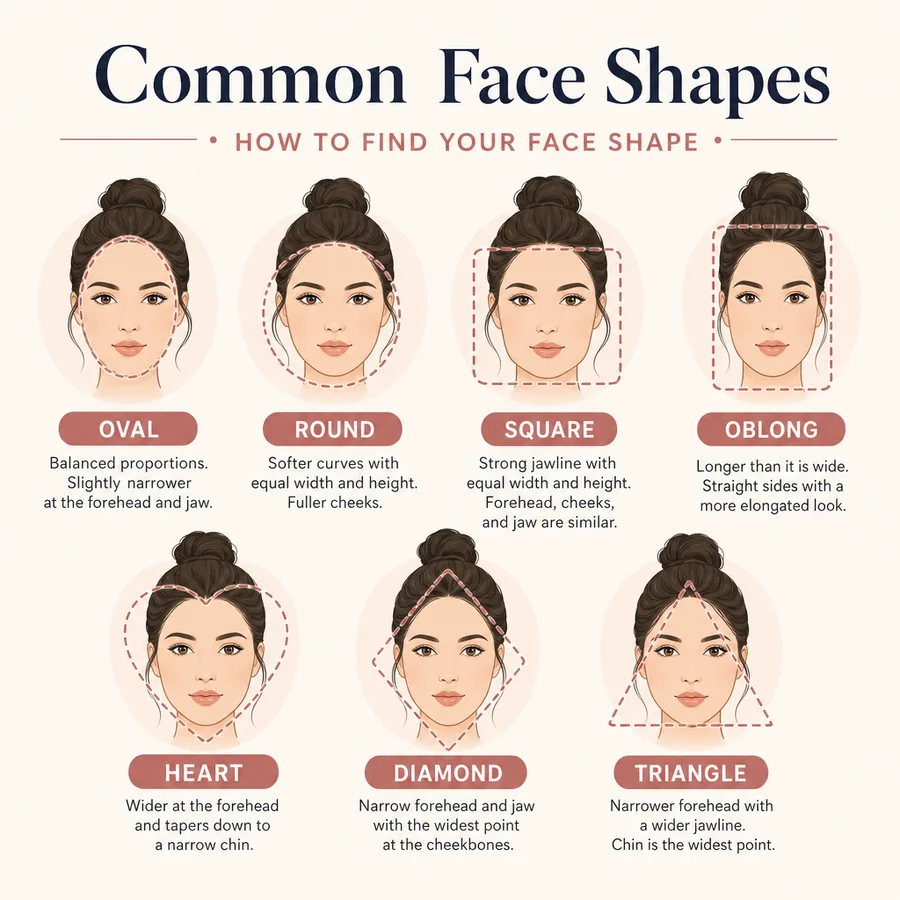
Use this chart after you measure. Do not treat it as a strict formula; treat it as a practical matching guide. If two rows sound close, read the tie-breakers in the next section before choosing your final answer.
| Face shape | Widest point | Length vs width | Jawline | Best clue |
|---|---|---|---|---|
| Oval | Cheekbones or forehead | Face length is greater than width, but not extremely long | Soft and gently rounded | Balanced proportions with no very sharp or very wide lower face |
| Round | Cheeks | Face length and width are close | Soft and curved | Fuller cheeks and little visible angularity |
| Square | Forehead, cheekbones, and jaw are similar | Length and width are close or moderately balanced | Strong, broad, and angular | The lower face has a clear squared edge |
| Rectangle / Oblong | Widths are often similar | Face length is clearly greater than width | Can be square or softly defined | The face reads long before it reads wide |
| Heart | Forehead | Can be short, balanced, or slightly long | Narrows toward the chin | Wider upper face with a smaller or pointed chin |
| Diamond | Cheekbones | Often slightly longer than wide | Narrower jaw and chin | Cheekbones stand out while forehead and jaw are both narrower |
| Triangle / Pear | Jawline | Varies | Broadest part of the face | Lower face is wider than forehead and cheekbones |
How to identify each face shape
Once you have the measurements, use the descriptions below to confirm the closest match. The best test is whether the description still fits in a clear front-facing photo without makeup, hair volume, or a camera angle doing the work.
Oval face shape
An oval face usually has more length than width, a forehead slightly wider than the jaw, and a softly rounded lower face. The proportions feel balanced rather than dramatic.
Common mix-up: oval vs oblong. If length dominates strongly, oblong may be more accurate.
Round face shape
A round face often has similar length and width, fuller cheeks, and a soft jawline. The face reads curved rather than angular.
Common mix-up: round vs square. If the jaw is broad and angular, square may be closer.
Square face shape
A square face usually has similar widths across the forehead, cheekbones, and jaw, with a strong jawline that creates a defined lower edge.
Common mix-up: square vs rectangle. If the face is clearly long, rectangle is usually a better label.
Rectangle or oblong face shape
A rectangle or oblong face is noticeably longer than it is wide. The forehead, cheekbones, and jaw may be similar in width, but length is the dominant impression.
Common mix-up: oblong vs oval. Oval is elongated, but oblong reads longer and more vertical.
Heart face shape
A heart face often has a wider forehead or upper face and a narrower chin. The jaw tapers downward rather than staying broad.
Common mix-up: heart vs diamond. Heart usually has a wider forehead; diamond usually has cheekbones as the widest point.
Diamond face shape
A diamond face has prominent cheekbones, with both the forehead and jawline narrower than the midface. The chin may look narrow or slightly pointed.
Common mix-up: diamond vs heart. Check whether the forehead or cheekbones are truly widest.
Triangle or pear face shape
A triangle face is widest at the jaw and narrower at the forehead. The lower face carries the strongest visual weight.
Common mix-up: triangle vs square. Square has similar upper and lower widths; triangle is wider below.
What if you are between two face shapes?
Being between two face shapes is common. Faces are continuous, while labels are simplified categories. If your measurements do not produce a clean answer, choose the shape that explains the strongest visual pattern, then note the secondary influence. For example, you may be mostly oval with a heart-shaped upper face, or mostly square with some round softness in the cheeks.
The simplest tie-breaker is to ask which feature would change your styling advice the most. A strong jaw affects glasses and haircut choices differently from a pointed chin. A long face affects volume placement differently from a short round face. Use the feature that matters most in real decisions.
| Common mix-up | What to check | How to decide |
|---|---|---|
| Oval vs oblong | Does face length strongly dominate the face? | Choose oblong if the face reads clearly long; choose oval if proportions feel balanced. |
| Round vs square | Is the jaw soft or angular? | Choose round for a curved lower face; choose square for a broad, defined jaw. |
| Heart vs diamond | Is the forehead or cheekbone area widest? | Choose heart when the upper face is widest; choose diamond when cheekbones dominate. |
| Triangle vs square | Is the jaw wider than the forehead? | Choose triangle if the lower face is widest; choose square if widths are similar. |
Manual measurement vs AI face shape detector
Manual measurement is excellent when you want to understand why a label fits. It shows the relationship between your forehead, cheekbones, jaw, and face length. The downside is that measurement points can be hard to place, especially when hair covers the forehead or when a photo is taken from a flattering but distorted angle.
An AI face shape detector can help when you want a quick second opinion. Modern face analysis tools can estimate landmarks and proportions from a front-facing photo, then compare the visible outline against common face shape patterns. The result should still be treated as guidance, not an absolute verdict, because lighting, pose, expression, camera distance, and hair can change what the tool sees.
| Method | Best for | Pros | Limits |
|---|---|---|---|
| Mirror check | Fast first impression | No tools needed and easy to repeat | Subjective and affected by expression or hair |
| 4-measurement method | Understanding your proportions | Clear, repeatable, and easy to compare | Measurement points can be inconsistent |
| AI face shape detector | Second opinion from a clear photo | Fast, visual, and useful for mixed shapes | Photo quality and angle can affect the result |
Want a faster second opinion?
Use the face shape detector with a clear front-facing photo, then compare the result with the measurement guide and chart above.
Try the Face Shape DetectorCommon mistakes when finding your face shape
Most wrong answers come from reading a temporary photo effect as facial structure. Before choosing a face shape, check the common issues below.
Using a close selfie
A phone held too close can stretch central features and distort the outline. Step back, keep the camera at eye level, and crop the image later.
Leaving hair over the face
Bangs, volume, and side pieces can hide the real forehead and jawline. Pull hair away before measuring or taking a reference photo.
Only looking at the chin
A pointed or rounded chin matters, but it is not the whole face shape. Compare it with the forehead, cheekbones, and face length.
Confusing weight with face shape
Weight changes can soften or sharpen features, but the underlying proportions often remain similar. Focus on structure rather than temporary fullness.
Tilting the head
A tilted chin or angled camera can make one side of the jaw look stronger and can exaggerate length or width. Use a level, front-facing view.
Forcing one perfect label
A mixed answer is often more accurate than a rigid one. Dominant shape plus secondary influence is a useful way to describe real faces.
What to do after you find your face shape
Once you know your closest face shape, use it as a styling guide rather than a rulebook. Oval faces often have flexible styling options, round faces may use height or angles for contrast, square faces may soften or echo the jawline, heart faces often balance a wider forehead, diamond faces can work around prominent cheekbones, and oblong faces often benefit from width and less vertical length.
The most useful next step is to apply the result to one decision at a time. If you are buying glasses, start with frame width and shape. If you are choosing a haircut, look at where volume sits. If you are trying makeup, focus on where contour, highlight, or blush changes the visual balance. A face shape label is only valuable when it helps you make choices with less guesswork.
Frequently asked questions
Use the 60-second visual check: find the widest part of your face, compare face length with width, and study whether your jaw is soft, square, narrow, or broad. This gives a useful first answer, but measurements are better when two shapes seem close.
Use a front-facing photo taken at eye level in natural light. Pull hair away from your forehead and jaw, keep a neutral expression, and avoid close wide-angle selfies. Then compare forehead width, cheekbone width, jawline width, and face length.
Yes. Many people have a dominant face shape plus a secondary influence. For example, someone may be mostly oval with a slightly heart-shaped forehead, or mostly square with softer roundness in the cheeks.
Weight can change how full or sharp the face appears, but it usually does not fully rewrite the underlying structure. For face shape identification, focus on bone structure, proportions, jawline, and the widest part of the face.
An AI face shape detector can be useful for a fast second opinion, especially when your features sit between two categories. Accuracy depends on photo quality, camera angle, lighting, expression, and whether hair blocks the face outline.
Very square, very round, and clearly oblong faces are often easier to identify because one pattern dominates. Oval, heart, and diamond can require more careful comparison because their differences are often subtler.
There is no single best face shape for glasses. The practical goal is balance: round faces often benefit from angular frames, square faces may like softer curves, heart faces often balance width, and oblong faces may prefer frames with visual depth.
References and further reading
These sources informed the measurement approach, styling context, and computer-vision background behind this guide.