Use a neutral view
Stand or sit facing a mirror with your head level, your jaw relaxed, and your hair away from the cheeks and jawline. A straight view is easier to compare than a tilted selfie.
Manual measurement tool
Enter your face length, forehead width, cheekbone width, and jawline width using the same unit. This face shape calculator turns those proportions into a practical starting point, so you can compare a manual result with our photo-based face shape detector instead of guessing from one feature.
Use a mirror, a soft measuring tape, or a clear front-facing photo. The calculation happens in your browser, so the numbers stay on this page and no photo is required.
Your calculated result
Signals behind this estimate
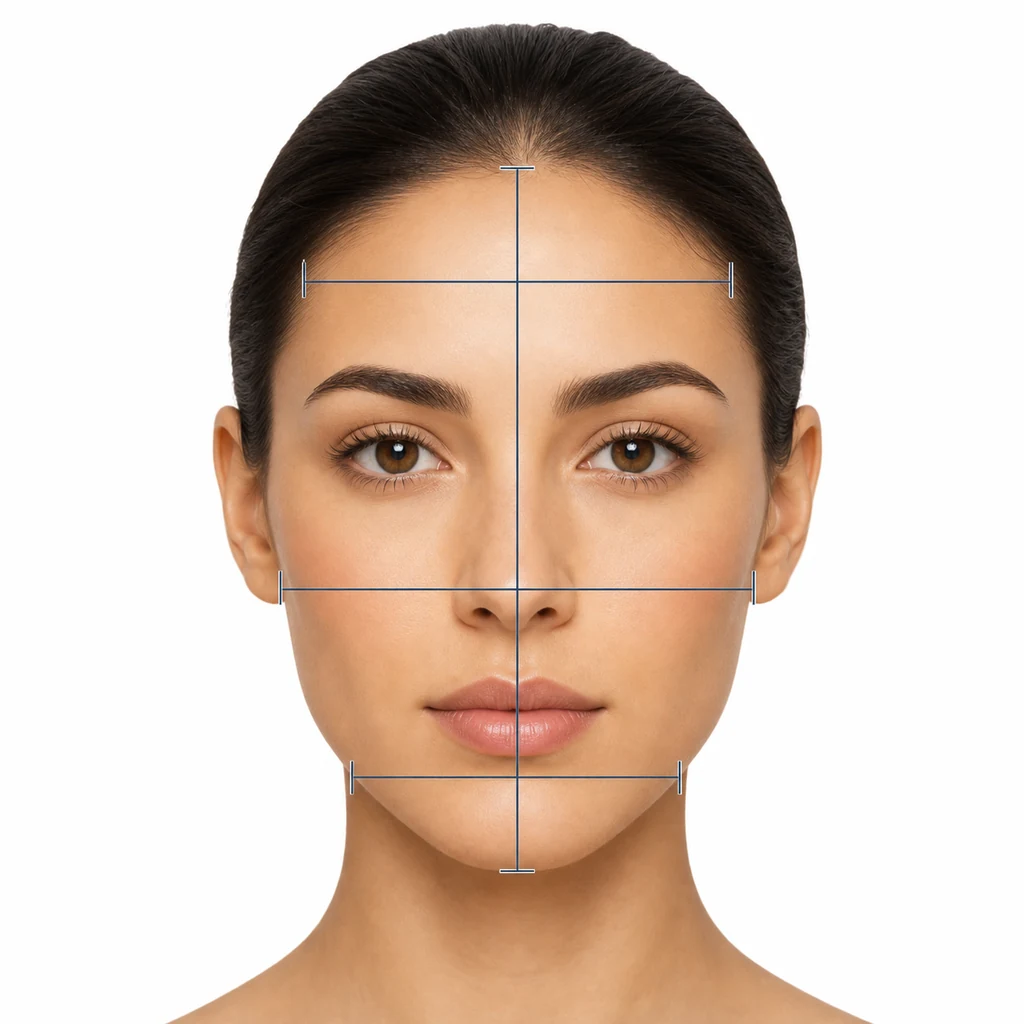
Example: 19 cm face length, 14 cm forehead, 15 cm cheekbones, and 12 cm jawline produce a longer, cheekbone-led estimate rather than a diagnosis.
Small changes in camera angle or tape placement can change a result. These steps make your four inputs easier to compare.
Stand or sit facing a mirror with your head level, your jaw relaxed, and your hair away from the cheeks and jawline. A straight view is easier to compare than a tilted selfie.
Measure from the center of the hairline to the bottom of the chin. If your hairline is difficult to see, use the same visible starting point each time and note that the estimate is approximate.
Measure the widest forehead area, the fullest cheekbone span, and the broadest jawline span. Do not wrap the tape around your head; the calculator expects straight horizontal widths.
Centimeters and inches both work, but never mix them. The result depends on ratios, so consistency matters more than the specific unit or a perfect decimal.
A face shape label is a visual shorthand, not a medical or identity category. The calculator uses simple comparison rules so you can see why a result appears.
The first check compares face length with the widest horizontal measurement. A noticeably higher ratio supports an oblong result, while a compact ratio supports round or square patterns.
Cheekbones that stand out from both forehead and jawline support a diamond pattern. A jawline that clearly leads points toward triangle, while a wider forehead with a narrow jawline supports heart.
When forehead, cheekbone, and jawline widths stay close, the calculator checks the length ratio and returns square, round, or oval depending on the overall balance.
Real faces often sit between categories. Use the result as a comparison starting point, then check the face shape chart or a photo-based detector for a second perspective.
The result describes proportions only. It does not rank faces, predict attractiveness, or recommend a cosmetic procedure.
Once you know the strongest proportion, you can compare glasses, hair, beard, makeup, or contour ideas without pretending that one category controls every choice.
These tools answer related questions with different inputs. Use the method that matches what you have available.
| Method | Input | Best for |
|---|---|---|
| Face shape calculator | Four manual measurements | People who want transparent proportions and no photo upload. |
| Face shape detector | A clear front-facing photo | A quicker estimate when measuring the face is inconvenient. |
| Face shape chart | Visual comparison | Checking overlap between oval, round, square, oblong, heart, diamond, and triangle patterns. |
A home measurement is not a clinical measurement. Hair, expression, tape angle, and camera distortion can all change the numbers.
A face may combine traits from two or more categories. If two results seem plausible, compare the strongest signals rather than forcing a strict answer.
Glasses, hair, makeup, and facial hair depend on taste, fit, texture, and comfort. Face shape is only one input for a style decision.
This page describes visible proportions for general education. It does not assess health, diagnose a condition, or replace professional advice.
It needs face length, forehead width, cheekbone width, and jawline width. Enter all four values in centimeters or all four in inches so the proportions remain consistent.
Use a level mirror view, keep your head straight, move hair away from the face, and measure the four straight-line distances described above. A friend can help keep the tape level.
No. This calculator uses numbers you enter and explains the proportion rules. The detector uses a front-facing photo to estimate facial landmarks. They are complementary, not duplicate pages.
That is common. Compare the widest area and the length-to-width ratio, then review the oval, round, square, oblong, heart, diamond, and triangle descriptions in the chart. Mixed traits are more realistic than a rigid label.
The calculator performs the calculation in your browser and does not send the entered measurements to an analysis endpoint. You can clear the fields with Start over.
You can use it as a starting point, but frame width, bridge fit, comfort, prescription, and personal style matter too. Treat face shape as one helpful clue rather than a rule.
Use the related pages when you want a photo estimate or a visual explanation of each category.
Upload a clear front-facing photo for a quick best-fit estimate and a close secondary match.
Use the photo detectorFollow a practical measurement guide and learn how to compare forehead, cheekbone, jawline, and length cues.
Read the measurement guideCompare the common face shape categories and see why real features can overlap.
Open the face shape chart