Are Almond Eyes Rare? What the Shape Really Means
Are almond eyes rare? Learn why almond eyes are a common descriptive category, why exact rarity percentages are difficult to prove, and how to compare your own visible traits.
The quick answer
Almond eyes are not usually considered rare. They are one of the most commonly described eye-shape categories because many eyes have a horizontally elongated opening, softly tapered corners, and an iris that touches or nearly touches the upper and lower lids.
The exact frequency is harder to prove. Eye-shape labels are not recorded in population statistics like height or eye color, and a clinical measurement of the eye area is not automatically the same as a beauty label such as almond eyes.
The practical takeaway is simple: almond eyes are a normal, widely seen shape, while exact global rarity percentages should be treated cautiously unless a source defines the trait, the sample, and the method. Your useful question is whether almond is your main outline and whether hooding, angle, or spacing should be added.
How common are almond eyes, really?
In everyday beauty language, almond eyes are a common descriptive category. The label usually points to an eye opening that looks longer than it is tall, tapers gently at the corners, and shows limited white above or below the iris.
A reliable global percentage is much harder to support. Studies may measure eyelid height, canthal tilt, or periocular proportions, but those measurements do not automatically translate into a consumer label. Viral numbers are weak unless the source explains what was measured and who was included.
A better question is whether almond is your main outline and whether a secondary trait—such as hooded, upturned, downturned, close-set, or wide-set—also describes what you see.
Why rarity claims about almond eyes get confusing
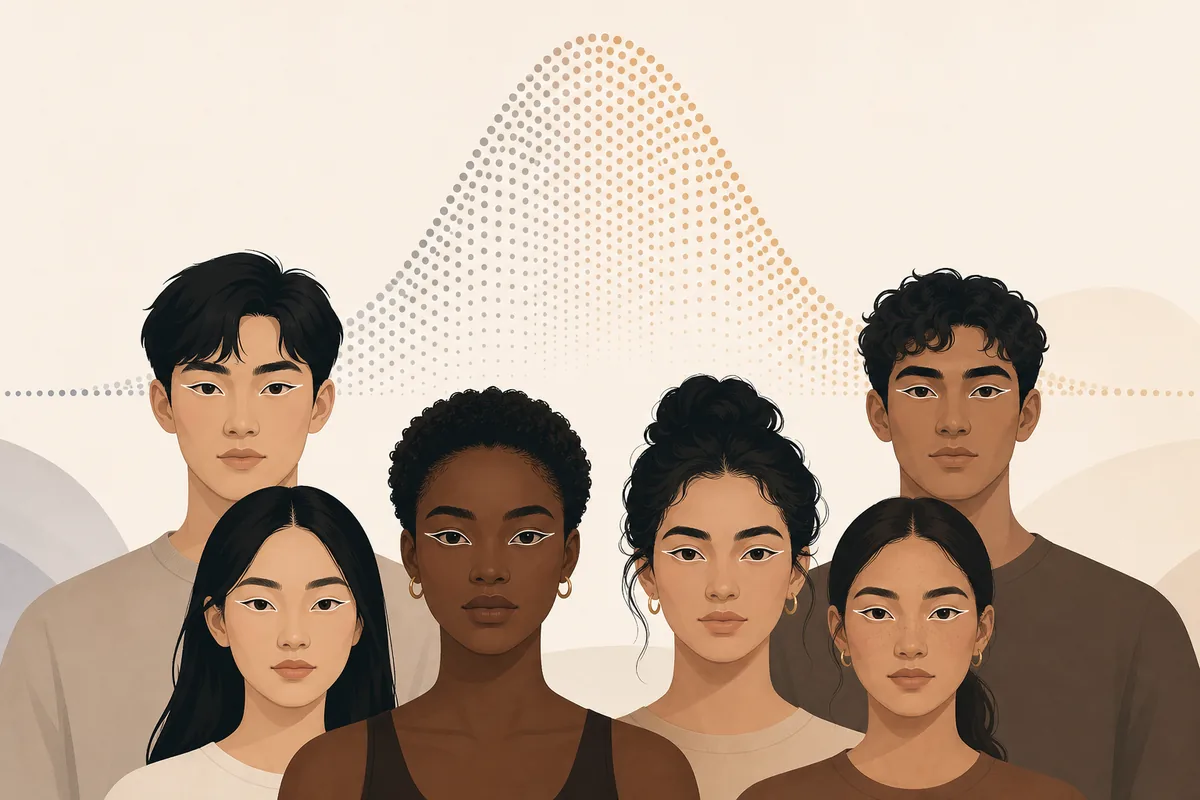
Rarity claims become confusing when they mix eye shape with eye color, ancestry, or a second structural trait. Keep those questions separate.
Shape is not color
Eye-color statistics do not tell you how common an eye-shape category is.
Shape is not ancestry
Almond-like outlines can appear across many backgrounds, so eye shape alone should not be used to infer ethnicity or ancestry.
Mixed traits are normal
A person can have almond eyes with hooding, an upturned or downturned corner, or close-set or wide-set spacing.
Numbers need methods
A percentage without a defined population, sample, measurement, and label is not enough to prove rarity.
How to judge your own almond-eye traits
Use a clear, front-facing photo in even light. Avoid heavy filters, raised brows, strong liner, and close wide-angle selfies when judging shape.
Check one feature at a time so you do not mix the outline with lid coverage, spacing, or corner direction.
Start with the outline
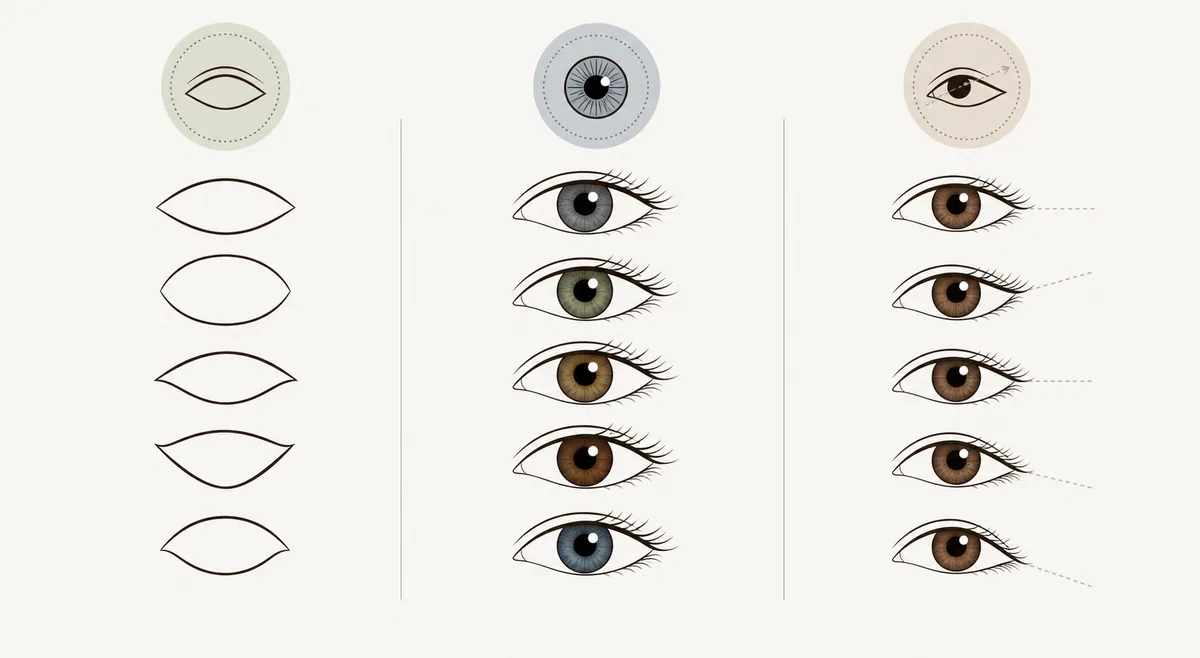
Ask whether the eye opening looks longer than it is tall.
- Almond eyes read horizontally balanced.
- Round eyes look more vertically open.
- A neutral expression gives the fairest comparison.
Check the iris
The iris often touches or nearly touches both lids in almond-eye descriptions.
- Extra white above or below may suggest round eyes.
- Lighting and expression can change what you see.
- Compare more than one image.
Check the corners
Outer-corner direction is separate from the overall almond outline.
- A lifted corner is upturned.
- A lowered corner is downturned.
- Either can coexist with almond eyes.
Add secondary traits
Only after the outline is clear should you add hooded, monolid, close-set, or wide-set labels.
- One label may be too simple.
- Layered descriptions are often more accurate.
- Use the detector as a second opinion.
Almond-eye claims: useful vs misleading
Use this table to separate a useful description from a claim that overreaches the available evidence.
| Claim | Better reading | Why it matters | What to check |
|---|---|---|---|
| Almond eyes are rare | Too broad without a method. | Rarity needs a defined population and definition. | Start with visible traits. |
| Almond eyes are common | Reasonable as a beauty-category statement. | Many guides use almond as a major shape type. | Confirm outline and iris contact. |
| Almond eyes define ancestry | Misleading. | Shape alone cannot establish identity or ancestry. | Avoid stereotype-based conclusions. |
| Almond eyes are always upturned | Not accurate. | Almond describes outline; upturned describes angle. | Compare inner and outer corners separately. |
What the answer means for makeup, lashes, and glasses
The styling value of the almond label is practical, not a ranking. A balanced outline can work with many liner, shadow, lash, and frame choices.
Secondary traits change the advice. Hooded almond eyes need visible placement above the fold; upturned almond eyes may need less outer lift; close-set almond eyes can look balanced when brightness stays near the inner corner and depth moves outward.
Use the label as a starting point, then check your actual photo and comfort. No eye shape needs to be corrected to be valid.
Hooded almond
- Keep detail visible with eyes open.
- Avoid overly thick liner.
- Use soft gradients.
Upturned almond
- Work with the natural lift.
- Keep wings proportional.
- Check both eyes open.
Close-set almond
- Lighten the inner corner.
- Move depth outward.
- Avoid heavy inner darkness.
Mixed result
- Use almond as the outline.
- Add one secondary trait.
- Retest with a neutral photo.
What we cannot honestly claim
We should not claim a precise global percentage for almond eyes without a clear source that defines the trait and measures it consistently.
We should also not infer identity, health, personality, or attractiveness from eye shape. The label is useful for self-description and styling, not for ranking people.
The careful answer is that almond eyes are a common and normal category, while exact rarity numbers are usually not reliable.
When an AI eye-shape detector helps
An AI detector can help when your real question is whether almond is the best label for your own photo. It compares visible cues such as lid visibility, iris exposure, corner direction, and spacing.
Use a clear front-facing photo and treat the result as a structured second opinion. A layered output can be more useful than a single dramatic label.
Use the detector as a second opinion
Check your outline, iris contact, corner direction, and secondary traits first, then compare the photo result with the guide.
Frequently asked questions
They are generally treated as a common descriptive eye-shape category, but no reliable global percentage proves an exact frequency.
There is no dependable single number. Treat percentages cautiously unless the source defines the trait, population, sample, and method.
Yes. Almond describes the outline, while hooded describes crease coverage. Both traits can occur together.
Yes. Almond-like outlines can appear across many backgrounds, and shape alone should not be used to infer ancestry.
Use a neutral front-facing photo and check the outline, iris contact, corner taper, and any secondary traits together.
References and further reading
These sources support careful wording around eye-shape labels and periocular variation; they do not establish a universal almond-eye percentage.